
.jpg)
Ethical agency is shaped by person, relationship, system, and time.
Leadership development is commonly measured as knowledge gained or behaviours adopted. Yet organisations still experience predictable governance activation failures: policies exist, escalation routes exist, codes of conduct exist—then judgement behaves differently under pressure.
This is not primarily a compliance problem.
It is a capacity problem:
Can ethical judgement remain accessible when the conditions that support it strain?
When ethical agency degrades, governance rarely fails loudly. It fails subtly—through delay, rationalisation, avoidance of escalation, relational self‑protection, and the displacement of ownership until consequences can no longer be contained.
And because these failures don’t always present as “misconduct,” they show up where leaders and boards actually measure:
Risk also loses visibility: concerns are raised but closure time stretches, and psychosocial control weakens as escalation and risk response slow—reflected in risk assessment outcomes, complaints, and claims.
So the question that matters is not:
Do leaders know what to do?
It is:
Can they remain capable of ethical judgement when the conditions become difficult?
Ethical agency is sustained—or lost—across four linked dimensions. The Serpent Path addresses each lever directly, as a single passage—not scattered training.
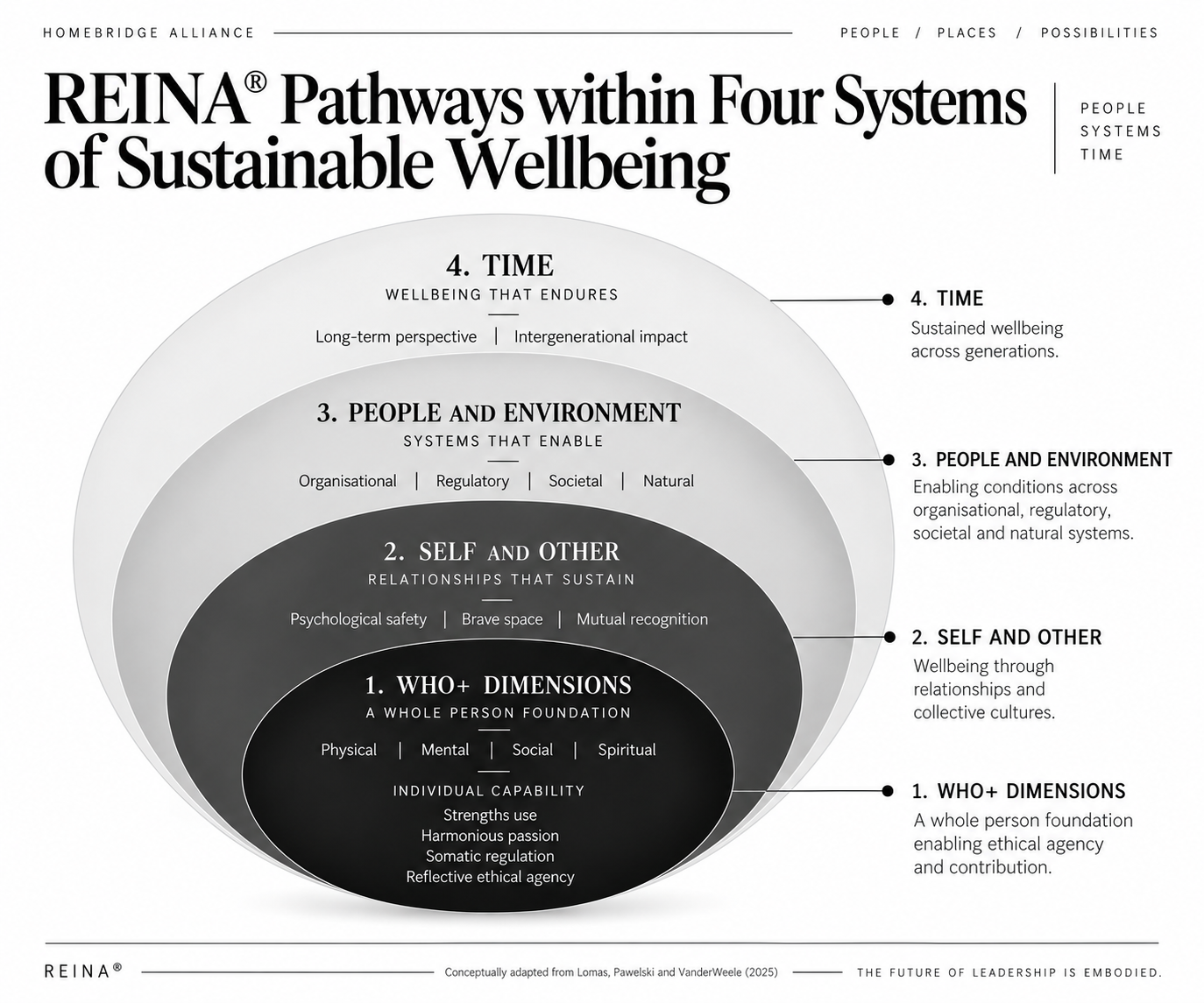
Pressure does not only affect thinking. It changes the physiological and attentional conditions that make ethical identity available—nervous system state, attention bandwidth, sensory range, emotional regulation, and relational openness.
When access shrinks, judgement becomes less stable. The first visible sign is governance breakdown: slower escalation, degraded decision-cycle integrity, and delayed or incomplete corrective action.
Implication: capability must be rebuilt as embodied capacity, not only as a cognitive update.
Ethical judgement depends on whether leaders can disagree without punishment and challenge without collapse.
Under sustained pressure, the “cost of truth” becomes internalised. Eventually, silence feels professional.
Implication: the programme must expand relational range under genuine uncertainty—so ethical judgement stays available, not socially negotiable.
What it tends to look like in practice: faster, clearer escalation; fewer avoided issues; higher integrity when corrective action is required.
Governance doesn’t only shape what leaders decide. It shapes what the whole system makes easy to say and hard to act on—for teams, regulators, customers, suppliers, and investors. Ethical agency fails when the system trains stakeholders to protect themselves from truth.
A practical test is this: where does good faith go under pressure?
Implication: embed “activation of judgement” across the stakeholder pathway—so truth is operationally rewarded through speed, quality, and follow‑through, not only socially acknowledged.
Where it shows up in system-level metrics:
Durability is a design outcome of the Serpent Path: reincorporation rehearses and reinforces the systemic conditions that keep ethical judgement available when throughput pressure, ambiguity, and stakeholder scrutiny reassemble—i.e., it closes the activation gap rather than relying on leaders to “return to type.”
Across time, executives re-enter familiar positions:
In that re-entry cycle, an unintegrated learning shift often weakens—not because insight disappears, but because conditions reassemble the old reflexes under strain.
Implication: reincorporation must be designed as stakeholder-relevant re-entry—so restored ethical capacity is reinforced at the points where interruption, deadlines, and incentive pressure would otherwise degrade judgement availability.
Where it shows up in durability metrics (tracked over time):
There is a stage in senior leadership when what once supported effectiveness starts to demand a toll.
The toll often looks like:
In Serpent Path terms, this is ecdysis: success can harden old ways of thinking into containment. The passage creates enough distance from what previously worked to make room for what must change—and what must be completed.
This is why the programme is not framed as “more training.”
It is framed as a structured passage.
Identity change is not an intellectual update. It is embodied transformation that requires three phases:
Before the retreat, participants complete Baseline Diagnostic work. This establishes the “before” state: the patterns already shaping judgement and executive habit. Separation here is operational. It quiets the reflex to perform competence and redirects attention to how ethical agency functions in practice.
The retreat (4 days / 3 nights) is held in a restricted container (20 women) to preserve safety and depth.
Within liminality, leaders practise:
Environmental psychology supports that natural contexts can support attentional restoration and stress recovery—mechanisms relevant to leadership judgement.
The Serpent Path uses nature intentionally—not as scenery, but as part of the design that supports:
Nature does not “cause” better decisions in isolation. It alters the physiological and attentional conditions in which judgement becomes available again.
A retreat without integration becomes a memory. The Serpent Path treats integration as governance‑relevant work.
The 11‑week integration workflow includes:
This stage matters because ethical agency is not only internal. It is relational and systemic. Leaders need supported mechanisms that translate restored judgement into accountable action that survives return to real operating conditions.
The Serpent Path finishes the work: reincorporation iterates learning into interventions, support, and operating behaviour—so restored capability does not collapse when pressure returns.
A board cannot govern a spreadsheet.
Boards can govern the conditions that determine how judgement is activated by people.
When leadership development produces insight without changing conditions, organisations still experience gaps.
The Serpent Path addresses those gaps by treating human capacity as a governance input, and by building a programme that changes the human container for judgement in ways designed to survive return to real operating conditions.
The Serpent Path does not offer a quick fix. It avoids behavioural buzzwords because what is being worked on is not superficial performance.
The promise is simpler—and more operational:
What brought you here need not define what comes next.
And sometimes, what comes next requires a leader to change her relationship to authority—without becoming someone else.
Not louder confidence. Not better rhetoric. But steadier ethical agency across the realities of person, relationship, system, and time.
If ethical agency is the capacity that makes governance real, then leadership development that ignores identity, embodiment, relational safety, systemic activation conditions, and reintegration is incomplete.
The Serpent Path is built to complete it—through separation, liminal retreat, and reincorporation.
If you are an executive woman in transition and feel the old container can no longer hold what your values require—this passage may be for you.
Attribution
With deep gratitude to my teachers and formidable practitioners at #CenterforWellbeingScience, to the MAPP community, and to my HBA family—a force behind the vision.
REFERENCES
Dong, R. K., Li, X., & Hernan, B. R. (2024). Psychological safety and psychosocial safety climate in workplace: A bibliometric analysis and systematic review towards a research agenda. Journal of Safety Research, 91, 1–19. https://doi.org/10.1016/j.jsr.2024.08.001
Edmondson, A. C. (1999). Psychological safety and learning behavior in work teams. Administrative Science Quarterly, 44(2), 350–383. https://doi.org/10.2307/2666999
Hobfoll, S. E., Halbesleben, J., Neveu, J.-P., & Westman, M. (2018). Conservation of resources in the organizational context: The reality of resources and their consequences. Annual Review of Organizational Psychology and Organizational Behavior, 5, 103–128. https://doi.org/10.1146/annurev-orgpsych-032117-104640
Lomas, T. (2019). The elements of eco-connection: A cross-cultural lexical enquiry. International Journal of Environmental Research and Public Health, 16(24), 5120. https://doi.org/10.3390/ijerph16245120
Lomas, T., Pawelski, J. O., & VanderWeele, T. J. (2025). Flourishing as ‘sustainable well-being’: Balance and harmony within and across people, ecosystems, and time. The Journal of Positive Psychology, 20(2), 203–218. https://doi.org/10.1080/17439760.2024.2362435
Niemiec, R. M. (2018). Character strengths interventions: A field guide for practitioners. Hogrefe.
Oades, L. G., Jarden, A., Hou, H., Ozturk, C., Williams, P., Slemp, G. R., & Huang, L. (2021). Wellbeing literacy: A capability model for wellbeing science and practice. International Journal of Environmental Research and Public Health, 18(2), 719. https://doi.org/10.3390/ijerph18020719
Porges, S. W. (2021). Polyvagal theory: A biobehavioral journey to sociality. Comprehensive Psychoneuroendocrinology, 7, 100069. https://doi.org/10.1016/j.cpnec.2021.100069
Ryan, R. M., & Deci, E. L. (2017). Self-determination theory: Basic psychological needs in motivation, development, and wellness. Guilford Press.
Turner, V. (1969). The ritual process: Structure and anti-structure. Aldine.
Vallerand, R. J., Blanchard, C., Mageau, G. A., Koestner, R., Ratelle, C., Léonard, M., Gagné, M., & Marsolais, J. (2003). Les passions de l’âme: On obsessive and harmonious passion. Journal of Personality and Social Psychology, 85(4), 756–767.
World Health Organization. (1948). Constitution of the World Health Organization. World Health Organization.WHO Constitution