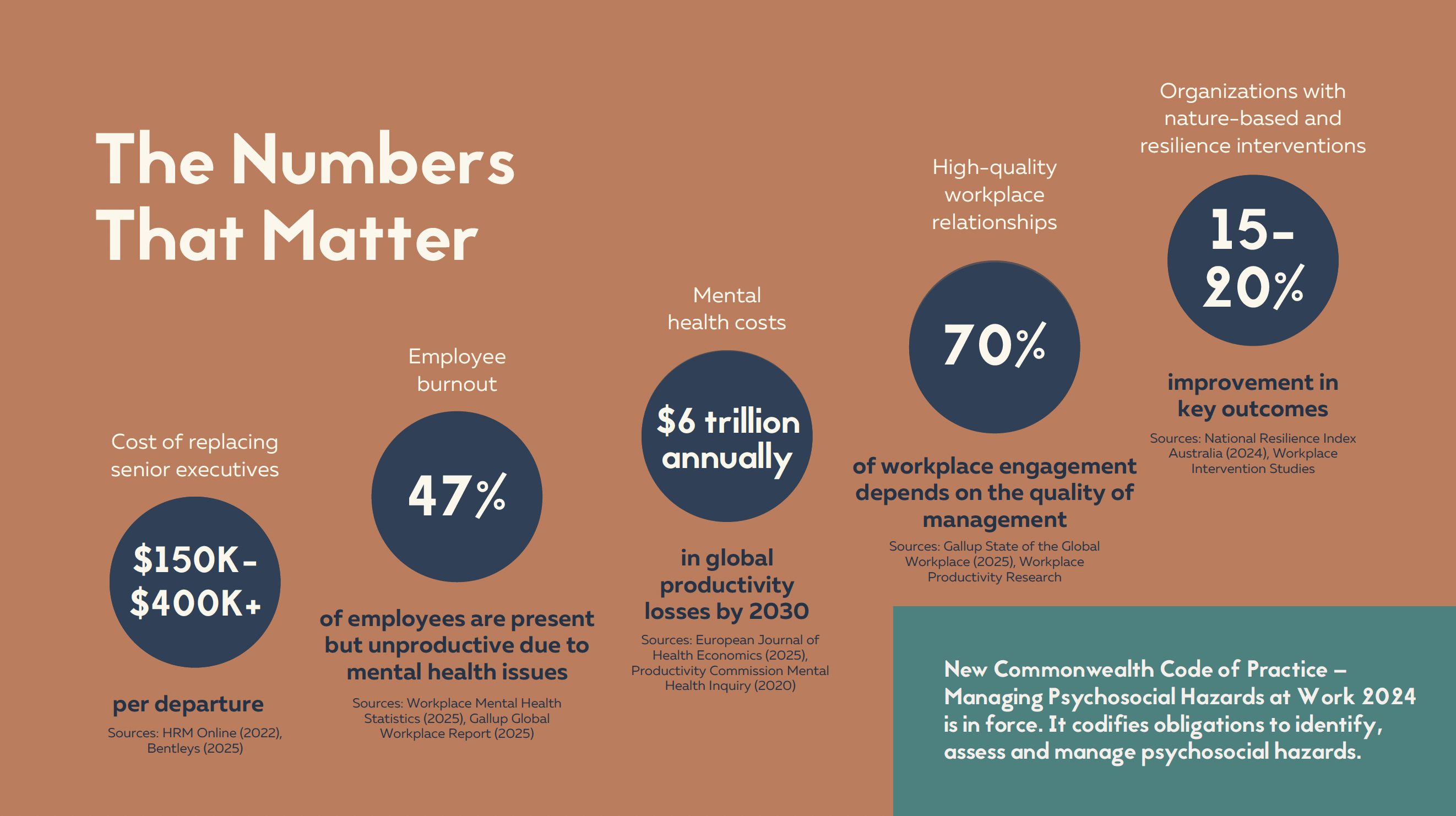
Regulatory expectations have shifted. Psychosocial hazards—excessive jobdemands, low control, role conflict, bullying, poor change management—must now be actively identified and managed under Australian WHS law.
These pressures do not stop at work. A well-established work–family inbalance is now intensified: competing demands between work and caregiving responsibilities increase stress, reduce wellbeing, and erode performance.
The impact on the next generation is visible. Between 2010 and 2019, rates of depression and anxiety among teenagers nearly doubled.
Information dissemination for continuous professional learning ticks the boxes but may not applied in practice. Experience builds competence and resilience.
Peer-witnessed rites of passage that mark transitions with meaning and support
Without these, leaders and their teams navigate major transitions without shared language, embodied challenge, or collective unity.
HBA exists to bride humans to the safety of home through:
• Guided by excellent practitionerss with first hand experience
• Wellbeing literacy
• Modern rites of passage
Homebridge® Alliance responds to conditions already present—and no longer solvable in isolation.
Whale Path is born out of care for people – in leadership roles, navigating duty of care.
In Australia, CMHAA data shows 46% of employees experiencing some degree of burnout at work, with 40% expecting stress and burnout to worsen in 2025.
Whale Path exists to provide the resources required to sustain high-demand environments, reimagining leadership development and compliance training as a shared practice of organisational culture transformation. It co-designs both accountability requirements and human care with the people responsible for enacting them within organisations.
Under the WHS Regulations (amended 2022–2024) and Safe Work Australia Codes of Practice, a Person Conducting a Business or Undertaking (PCBU) must identify, assess, control, and review psychosocial hazards. Compliance is not assessed by intent or participation, but by evidence of practice.
Australian guidance recognises 15 psychosocial hazards, including:
• High job demands
• Poor support
• Low job control
• Low role clarity / role conflict
• Poor organisational change management
• Low reward and recognition
• Poor organisational justice
• Workplace conflict
• Harassment (including sexual harassment)
• Bullying
• Exposure to traumatic events or material
• Violence and aggression
• Remote or isolated work
• Poor environmental conditions (when interacting with psychosocial load)
• Fatigue (including cognitive and decision fatigue)
Have you considered those risks? Have you assessed alternatives?
HBA work strengthens organisational efforts to manage Psychosocial Safe Climates.
Women in the workforce do not lack power; many are operating within unsustainable conditions. Amid widespread organisational change, women’s ambition has not diminished — it has become more discerning.
COVID-era leadership research showed women leaders carrying a disproportionate burden of emotional labour, people management, care coordination, and organisational holding.
Serpent Path rejects the language of “empowering women” — a framing increasingly experienced by senior women as patronising, performative, and detached from operational reality. Instead, it responds directly to the distinct pressures, contradictions, and leadership demands women navigate within contemporary workplaces.
The 21st-century leadership pipeline is becoming AI-obscure: technical competence is no longer a differentiator. What compounds over time are non-replicable human capacities—learning modalities, agency, and moral reasoning enacted by example. HBA Next Gen develops this Core Human Advantage before behavioural patterns harden.
We are facing a global loneliness crisis, with adolescents and young adults at highest risk. Modern culture has socialised young people toward status, wealth, recognition—patterns associated with higher anxiety, lower wellbeing, and fragile self-worth. Families are increasingly digitally connected but emotionally fragmented, producing a failure of relational infrastructure.
HBA supports development of balance goals this through differentiated developmental pathways:
• Eagle Path (Mother/Woman Mentor & Son): stabilises autonomy and emotional regulation so independence does not become withdrawal.
• Swan Path (Mother/Woman Mentor & Daughter): strengthens voice and boundary authority, interrupting over-adaptation patterns common in young women.
• Raven Path (Gender-inclusive): develops systems-based leadership, plural-reality navigation, fair negotiation, and collective accountability.
Contemporary research in social psychology and adolescent development converges on three non-negotiables in the pre-teen years: mastery experiences, emotional vocabulary, and safe challenge. Without these, resilience does not consolidate.
Yes — when structured, bounded, and earned. The evidence is clear on conditions, not on prestige alone.
HBA Sponsorship is the Alliance in action—a developmental bridge for ages 14–18 that creates an exchange between current industry leaders and emerging talent.
Across developmental psychology, education, and organisational research, programmes that involve high-status adult mentors or sponsors produce positive outcomes only when three conditions are met:
1. Psychological safety and structure. Trauma-informed, predictable environments significantly improve engagement, learning, retention, and self-efficacy in adolescents. This is well established in youth development, mentoring, and trauma-informed education literature.
2. Role-model proximity with boundaries. Adolescents benefit from experiencing how to achieve their goals with those who embody future roles.
3. Merit-based or earned participation. Sponsorship models outperform open networking because they:
· reduce status anxiety
· signal seriousness and standards
· strengthen internalised agency and responsibility
This is why sponsorship (vs mentoring) is strongly associated in leadership research with long-term advancement, ethical formation, and retention — particularly for underrepresented groups.